
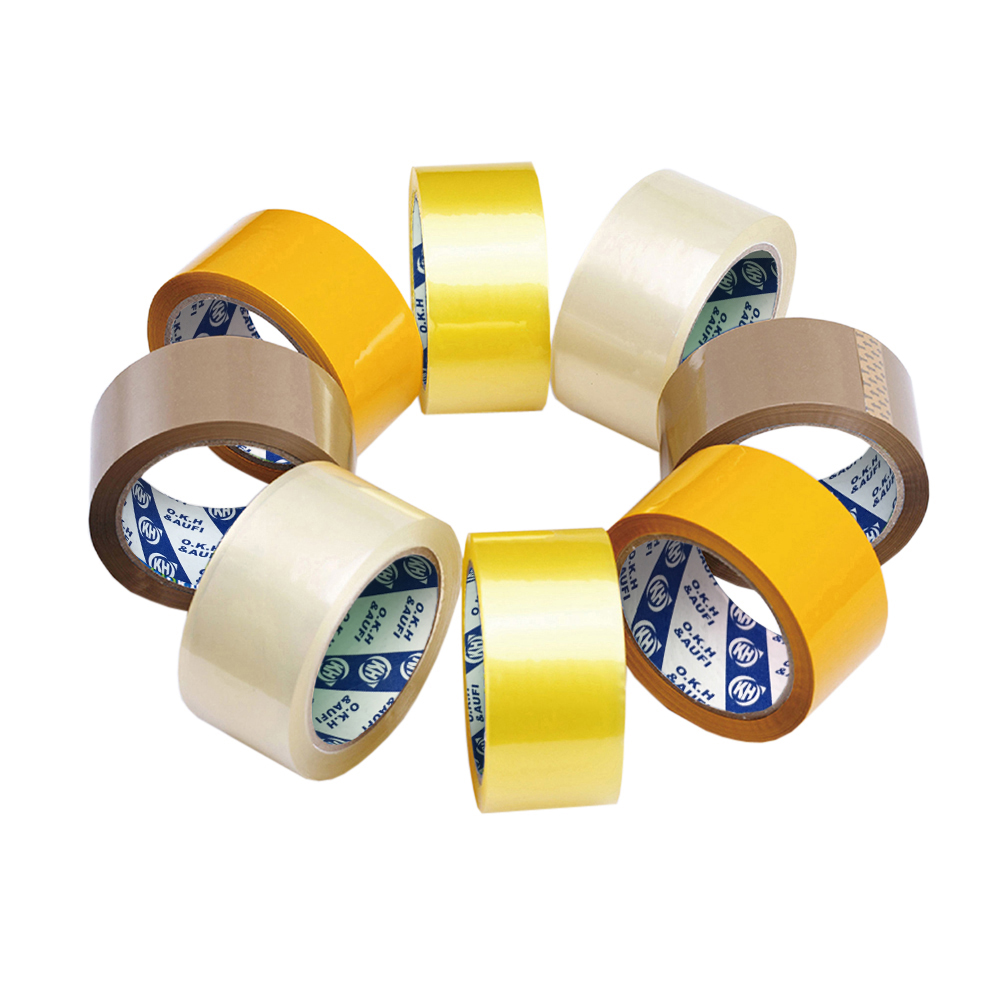

How Does Regular Packing Tape Transform From Crude Oil Into Finished‑Hand‑Held Products?
Most people use carton‑sealing tape every day, yet few understand its complex production journey. This article walks you through every key manufacturing step of BOPP packing tape, from crude‑oil‑based raw materials to finished retail tape rolls, and explains why some tapes perform far worse than others.
01 Main Components of Tape
Before diving into the production workflow, let’s understand what packing tape consists of. Common transparent carton‑sealing tape mainly relies on three core raw materials.
- BOPP Film: The “backbone” of tape. It defines toughness, transparency and tensile strength, and features no inherent stickiness.
- Pressure‑Sensitive Adhesive (PSA): Source of tackiness. It forms firm bonding with light pressure without heating required.
- Release Agent: Anti‑stick coating applied on the tape backside, preventing tape layers from sticking to themselves.
All tape manufacturing revolves around processing, laminating and setting these three materials.
02 Upstream Raw Materials: Turning Crude Oil Into Film and Adhesive
Plastic feedstock for BOPP film originates from polypropylene (PP) pellets refined from crude oil, which demands strict production standards.
- Heat‑melt PP pellets and extrude them into thick flat sheets.
- Implement biaxial stretching: stretch the film in machine direction first, then cross‑machine direction, thinning and homogenizing thick sheets.
- Cool, set and wind into ultra‑wide BOPP master film rolls.
Stretched BOPP film delivers high transparency, outstanding toughness and good tear resistance, making it ideal tape substrate.
Key note: Raw BOPP film is non‑adhesive with extremely smooth surface. Direct adhesive coating will lead to complete glue delamination. Special surface modification is mandatory prior to coating.
Manufacturing Pressure‑Sensitive Adhesive Over 90% of civilian‑grade tapes on the market adopt water‑based acrylic pressure‑sensitive adhesive, featuring non‑toxic formula, safety and strong bonding performance. In industrial reactors, acrylic monomers, tackifier resins, emulsifiers and functional additives are mixed at precise ratios for emulsion polymerization, generating milky‑white PSA emulsion. Finished adhesive undergoes strict testing for viscosity, solid content and purity. After impurity filtration, it goes into storage. Its quality directly determines initial tack and long‑term holding power of tape.
Release Agent Preparation (Anti‑blocking Key) Silicone‑based release agent is coated onto film backside. Without this protective layer, wound tape rolls will stick tightly together and become unpeelable.
03 Core Process: Coating to Produce Giant Tape Master Rolls
Coating is one of the most critical procedures that dominate final product quality. All small retail tapes are converted from multi‑hundred‑kilogram master jumbo rolls.
- Unwinding & Feeding Mount wide‑width BOPP master film onto high‑speed coater. The equipment transports film at constant speed ranging from 50 ~ 150 m/min to guarantee uniform coating outcome.
- Corona Treatment (Critical Step) Poor‑quality tapes frequently suffer adhesive delamination, which usually roots in this step. High‑voltage electrical discharge bombards the adhesive‑receiving side, roughening smooth molecular surface and raising surface tension. Meanwhile, apply release agent evenly on film backside and perform preliminary drying.
- Insufficient treatment: Weak adhesive anchoring, tape easily peels off.
- Over‑treatment: Film becomes brittle and prone to snapping in application.
- Precision Adhesive Coating Comma‑blade coating method applies pressure‑sensitive adhesive uniformly onto pre‑treated film, with controllable adhesive layer thickness:
- Wet adhesive thickness: 30‑40 μm
- Dry adhesive thickness after oven drying: 15‑28 μm
Thicker dry adhesive normally delivers stronger tack, which serves as a major distinction between premium and inferior tapes.
- Multi‑zone Hot‑air Drying & Curing Coated film travels through multi‑section ovens of over ten meters long. Temperature ramps gradually from 50 °C up to 95 °C to evaporate water content inside adhesive. This stage governs tape stability:
- Incomplete drying: Residual moisture causes excessive stickiness and adhesive transfer to hands during usage.
- Excessive temperature gradient: Adhesive ages and fails; substrate turns brittle and breaks easily.
- Winding into Master Rolls & Temperature‑Controlled Maturation Dried adhesive‑coated film is continuously wound into jumbo master rolls, nearly one‑meter in diameter and weighing several hundred kilograms. Freshly produced master rolls cannot be converted immediately. They rest 24‑48 hours inside constant‑temperature warehouses. This allows full cross‑linking and curing of adhesive molecules, optimizing initial tack and shear holding power, and preventing unstable performance in later applications.
04 Forming Process: Converting Jumbo Master Rolls Into Retail‑Size Small Tape Rolls
Fully matured master rolls go to slitting‑rewinding workshops to produce small‑size consumer tape rolls.
- Paper Core Pre‑processing Large paper tube blanks are cut into standard widths: 45 mm, 48 mm, 60 mm and other common sizes, prepared as tape winding cores.
- High‑speed Slitting & Rewinding Mount jumbo master roll onto slitter. Multiple high‑speed circular knives operate simultaneously, longitudinally cutting wide master web into dozens of narrow standard tape strips. The machine rewinds tape precisely onto paper cores. Length is auto‑controlled: 100 m, 200 m, 300 m preset lengths trigger automatic stop once target value is achieved. Blade friction generates heat during high‑speed slitting, so continuous cooling is required. Otherwise, defects such as burrs, stringing and edge curling will occur.
05 Quality Inspection & Packaging: Final Barrier Before Shipment
Slit finished tapes cannot be packed directly and must pass strict inspections.
- Visual inspection: detect bubbles, wrinkles, uneven end faces, tape breakage and burr defects.
- Performance sampling test: professional instruments measure initial tack, peel strength, shear holding time and tensile strength.
Qualified products receive automatic labelling, individual shrink‑film wrapping, bulk packing and warehousing, then distributed to supermarkets, courier companies and other end‑markets.
06 Production Differences Among Common Tape Types (Extended Knowledge)
Besides standard transparent carton‑sealing tape, manufacturing processes vary significantly for other popular tapes:
- Double‑sided Tape: PSA coated on both substrate sides; one side protected by release liner which is peeled off before use.
- Duct Tape: Fabric‑reinforced backing. Dipped coating sets base shape, followed by secondary PSA coating for high elasticity.
- Masking Tape: Paper‑backed with rubber‑based PSA. It tolerates high temperature, tears easily by hand and leaves zero residue upon removal.
- Hot‑melt Tape: Zero water or solvent. Molten hot‑melt adhesive is directly coated; long oven tunnels are unnecessary with fast curing speed.
07 Root Causes Behind Poor‑Quality Tapes Available On‑Market
The full manufacturing workflow explains typical defects of low‑grade tapes:
- Easy peeling: insufficient corona treatment or inadequate adhesive bonding strength.
- Self‑blocking after storage: insufficient oven temperature or incomplete adhesive drying.
- Stringing & burr‑cut edges: dull slitting blades and insufficient cooling.
- Inconsistent tack: unstable adhesive formulation or uneven coating thickness.
- Frequent snapping: defective BOPP biaxial stretching and poor substrate toughness.
08 Closing Thoughts
A casual small roll of packing tape looks plain, yet it goes through a complete industrial chain: raw‑material synthesis, film biaxial stretching, corona surface modification, precision coating, gradient drying, constant‑temperature maturation, high‑speed slitting, final quality testing and packaging.
Industrial beauty lies within those ordinary daily commodities. Every well‑made small product is backed by sophisticated industrial manufacturing.