
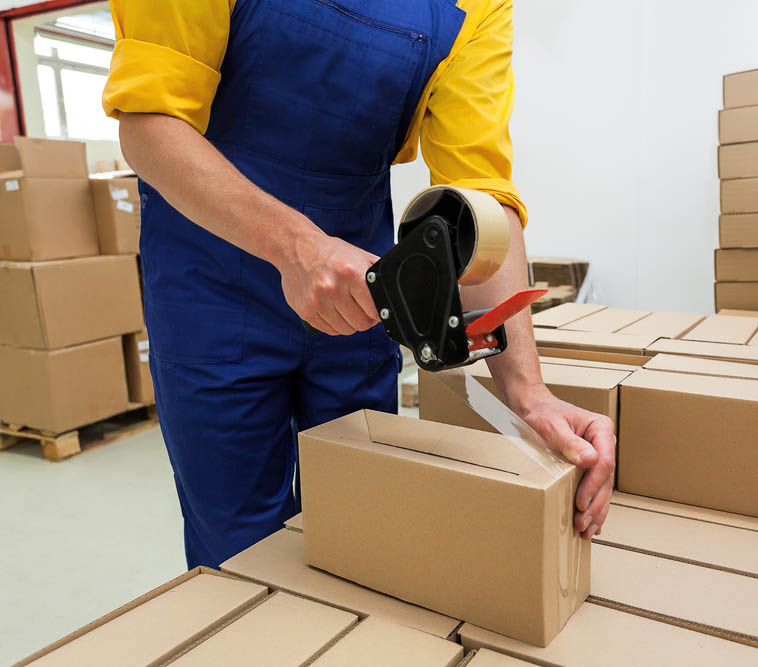

When choosing packing tape for carton sealing and general packaging applications, one of the most important factors is the adhesive system.
Two of the most widely used adhesive technologies for packaging tape are water-based acrylic adhesive and hot melt adhesive. Both can provide reliable carton sealing performance, but they have different characteristics in terms of adhesion, temperature resistance, aging stability, production process, appearance, and cost.
Understanding these differences is important for distributors, packaging companies, retailers, and industrial users when selecting the right packing tape for a specific application.
1. What Are Water-Based Acrylic and Hot Melt Adhesives?
Before comparing their performance, it is useful to understand the basic differences between the two adhesive technologies.
Water-Based Acrylic Adhesive
Water-based acrylic adhesive is an acrylic polymer adhesive system in which the adhesive components are dispersed or emulsified in water.
During the tape manufacturing process, the adhesive is applied to the BOPP film through a coating process. The coated tape then passes through a drying oven where water is removed, leaving a continuous acrylic adhesive layer on the film.
The resulting adhesive layer provides a combination of adhesion, aging stability, transparency, and resistance to environmental factors.
Water-based acrylic adhesive is widely used for general-purpose carton sealing tape, particularly where long-term storage stability and good appearance are important.
Hot Melt Adhesive
Hot melt adhesive is a solvent-free adhesive system that is applied in a molten state.
Unlike water-based acrylic adhesive, hot melt adhesive does not require water evaporation during coating. The adhesive is heated to a controlled temperature, coated directly onto the BOPP film, and then cooled to form the adhesive layer.
Hot melt adhesives are commonly formulated using synthetic rubber or thermoplastic elastomer systems together with tackifying resins, plasticizers, antioxidants, and other additives.
They are particularly well known for their high initial tack and fast bonding performance.
2. Water-Based Acrylic vs. Hot Melt: Key Differences
The following table provides a general comparison between the two adhesive systems.
| Performance | Water-Based Acrylic | Hot Melt |
|---|---|---|
| Initial Tack | Moderate | High |
| Instant Bonding | Good | Excellent |
| Long-Term Aging | Excellent | Good to Very Good |
| UV Resistance | Excellent | Moderate to Good |
| Heat Resistance | Good to Excellent | Moderate |
| Low-Temperature Performance | Good, depending on formulation | Good to Excellent |
| Transparency | Excellent | Good to Excellent |
| Odor | Generally Low | Can be higher depending on formulation |
| Adhesion to Rough Cartons | Good | Excellent |
| Shear / Holding Power | Good to Excellent | Good |
| Production Speed | Moderate | High |
| Environmental Stability | Excellent | Good |
| Typical Cost | Moderate | Competitive |
| Typical Application | General-purpose & long-term storage | High-tack & fast sealing |
These characteristics are general guidelines. Actual performance depends heavily on the adhesive formulation, coating weight, BOPP film quality, manufacturing process, and storage conditions.
3. Adhesion and Initial Tack
One of the most noticeable differences between water-based acrylic and hot melt packing tape is initial tack.
Hot melt adhesive generally provides higher initial tack. When the tape is applied to a carton, the adhesive can quickly wet the carton surface and develop strong initial bonding.
This makes hot melt tape particularly suitable for:
- High-speed carton sealing
- Automatic packaging lines
- Rough or recycled corrugated cartons
- Cartons with dusty surfaces
- Applications requiring immediate adhesion
- Packaging operations where the tape has limited contact time before the carton moves to the next process
Water-based acrylic adhesive generally develops adhesion more progressively. Its initial tack can be lower than that of a well-formulated hot melt adhesive, but this does not necessarily mean lower overall performance.
For applications involving normal carton surfaces and sufficient bonding time, water-based acrylic tape can provide very reliable sealing performance.
4. Long-Term Aging Performance
Long-term aging is one of the major advantages of acrylic adhesive technology.
Acrylic polymers generally have excellent resistance to aging, oxidation, and UV exposure. As a result, water-based acrylic packing tape can maintain relatively stable adhesive properties over extended periods.
This characteristic is particularly important when cartons are:
- Stored for long periods
- Exposed to sunlight
- Transported over long distances
- Stored in warehouses for months
- Used for products with long shelf lives
Hot melt adhesives can also provide good aging performance when properly formulated. However, their performance can be more sensitive to formulation and environmental conditions, particularly prolonged exposure to high temperatures and UV radiation.
Therefore, for applications requiring long-term storage and stable adhesive performance, water-based acrylic is often a preferred option.
5. Temperature Performance
Temperature is another important factor when selecting packing tape.
High-Temperature Conditions
Water-based acrylic adhesive generally performs well at elevated temperatures, particularly in terms of maintaining cohesive strength and resistance to adhesive flow.
This makes acrylic tape suitable for applications involving:
- Warm warehouses
- Long-distance transportation
- Seasonal temperature variations
- Extended storage periods
Hot melt adhesive can provide excellent bonding at normal temperatures, but certain hot melt formulations may soften when exposed to prolonged high temperatures.
Therefore, if the final application involves continuous exposure to elevated temperatures, an appropriately formulated acrylic adhesive may provide better long-term stability.
Low-Temperature Conditions
Hot melt adhesive is often recognized for its excellent initial tack, which can be advantageous in cold environments.
However, low-temperature performance depends strongly on the specific formulation. Not all hot melt adhesives perform equally well at low temperatures.
Water-based acrylic adhesives can also be formulated for low-temperature applications, but standard general-purpose acrylic packing tape may require sufficient application temperature to achieve optimal bonding.
For cold-chain or winter applications, the adhesive should therefore be selected according to the actual operating temperature rather than simply choosing an adhesive type based on its general classification.
6. Adhesion to Recycled and Rough Cartons
Modern packaging increasingly uses recycled corrugated cardboard.
Recycled cartons often have more irregular surfaces, higher levels of paper dust, and greater variability in surface energy compared with high-quality virgin-fiber cartons.
In these situations, initial tack and surface wetting ability become particularly important.
Hot melt adhesive generally has an advantage because of its high tack and fast wet-out characteristics.
This allows the adhesive to quickly establish contact with irregular carton surfaces.
For example, when sealing heavy cartons made from recycled corrugated board, hot melt packing tape can be an effective choice when immediate bonding strength is required.
However, a properly formulated acrylic adhesive can also provide excellent adhesion, particularly when the carton surface is relatively clean and the tape is given sufficient contact pressure.
7. Shear Strength and Holding Power
Initial tack is not the same as holding power.
A tape may stick very quickly but still have limited resistance to sustained stress.
Shear strength, sometimes referred to as holding power, describes the adhesive’s ability to resist movement when subjected to a continuous load.
Acrylic adhesives generally provide good cohesive strength and long-term stability. This makes them suitable for applications where the tape needs to maintain its bond over an extended period.
Hot melt adhesives, on the other hand, are typically designed to provide strong initial adhesion and fast bonding. Their cohesive strength depends strongly on the polymer and resin system used in the formulation.
Therefore, when selecting a packing tape, it is important to evaluate both:
Initial Tack + Long-Term Holding Power
rather than considering peel adhesion or tack alone.
8. Transparency and Appearance
Appearance can be an important consideration for packaging tape, especially for retail packaging and printed cartons.
Water-based acrylic adhesives can provide excellent clarity and a clean appearance when properly formulated and coated.
They are therefore commonly used when the tape needs to remain visually clear over the carton surface.
Hot melt adhesives can also be highly transparent, but their appearance depends on the adhesive formulation, raw materials, coating process, and aging conditions.
For premium clear packing tape, adhesive formulation and coating quality are both critical regardless of the adhesive technology.
9. Manufacturing Process
The two adhesive technologies also differ significantly in their production processes.
Water-Based Acrylic Coating
A typical process includes:
BOPP Film → Surface Treatment → Adhesive Coating → Drying → Cooling → Slitting → Packing
The adhesive coating contains a significant amount of water, which must be removed through controlled drying.
Therefore, drying temperature, coating weight, oven conditions, and coating uniformity are important factors affecting final tape performance.
Hot Melt Coating
A typical process includes:
BOPP Film → Surface Treatment → Hot Melt Adhesive Coating → Cooling → Slitting → Packing
Because the adhesive is applied in molten form, there is no water evaporation step.
This allows hot melt coating lines to operate at high production speeds.
However, precise temperature control is essential. Excessive temperature can affect adhesive properties, while insufficient temperature can lead to poor coating quality.
10. Cost Considerations
Cost should not be evaluated simply by comparing the price per kilogram of adhesive.
The actual manufacturing cost of packing tape is influenced by:
- BOPP film thickness
- Adhesive formulation
- Adhesive coating weight
- Adhesive consumption
- Production speed
- Energy consumption
- Raw material prices
- Slitting efficiency
- Packaging requirements
- Quality control requirements
Hot melt technology can offer production efficiency advantages because it does not require a water-drying process.
Water-based acrylic production, however, can provide excellent product stability and performance, particularly for applications where long-term storage and aging resistance are important.
Therefore, the most economical solution depends on the complete production and application requirements rather than adhesive price alone.
11. Which One Should You Choose?
There is no universal answer that one adhesive system is better than the other.
The correct choice depends on the application.
Water-Based Acrylic Packing Tape Is Often Preferred When:
- Long-term storage is important
- Good aging resistance is required
- UV exposure is expected
- Stable performance over time is important
- Excellent transparency is required
- The cartons have relatively clean surfaces
- The packaging environment has significant temperature variation
Hot Melt Packing Tape Is Often Preferred When:
- High initial tack is required
- Immediate bonding is important
- Automatic carton sealing is used
- Carton surfaces are rough or irregular
- Recycled corrugated cartons are used
- Fast packaging speed is required
- Strong adhesion is required with limited contact time
12. Adhesive Type Is Only One Part of Tape Performance
It is important to emphasize that the adhesive type alone does not determine the final performance of packing tape.
A high-quality packing tape is the result of the interaction between several components:
BOPP Film + Surface Treatment + Adhesive Formulation + Coating Weight + Coating Process + Slitting Quality
For example, two tapes may both be described as “water-based acrylic packing tape,” but their performance can be significantly different because of differences in:
- BOPP film thickness and tensile strength
- Corona treatment level
- Adhesive polymer composition
- Tackifier selection
- Coating weight
- Drying conditions
- Aging conditions
- Manufacturing controls
The same applies to hot melt tape.
Therefore, professional tape selection should be based on actual performance data and application requirements, rather than adhesive type alone.
13. How Should Packing Tape Be Evaluated?
For professional purchasing and quality control, we recommend evaluating packing tape using a combination of tests rather than relying on a single performance indicator.
Typical evaluation parameters include:
- Peel Adhesion
- Initial Tack
- Holding Power / Shear
- Tensile Strength
- Elongation
- Adhesive Coating Weight
- Tape Thickness
- Low-Temperature Adhesion
- High-Temperature Performance
- Aging Stability
- Unwinding Performance
- Noise Level
- Carton Sealing Performance
For automatic packaging applications, the actual performance on the customer’s packaging line should also be considered.
A tape that performs well in laboratory testing may still require adjustment if the application involves high-speed carton sealing, unusual carton materials, high dust levels, or extreme temperatures.
Conclusion
Both water-based acrylic and hot melt adhesives are mature technologies widely used in the packing tape industry.
Water-based acrylic generally offers advantages in aging stability, UV resistance, transparency, and long-term performance, making it an excellent choice for general-purpose packaging and applications requiring extended storage.
Hot melt adhesive is generally characterized by high initial tack, fast bonding, and excellent adhesion to many challenging carton surfaces, making it particularly suitable for high-speed packaging and applications involving recycled or rough corrugated cartons.
The best packing tape is therefore not necessarily the one with the “strongest” adhesive. It is the tape whose film, adhesive system, coating weight, and manufacturing process are properly matched to the customer’s actual application.
As a professional packing tape supplier, we believe that understanding the application is the first step toward selecting the right tape.
If you are unsure whether water-based acrylic or hot melt packing tape is more suitable for your application, our technical team can help evaluate factors such as carton material, storage temperature, packaging speed, required adhesion, and transportation conditions to recommend the appropriate solution.